Gamers often struggle to find people who share interests beyond the games themselves—making social discovery feel shallow. I owned research synthesis through task-flow architecture for a four-person EA-sponsored hackathon team. The work stayed at concept stage: a 24-hour sprint, not a shipped feature.
- Problem
- Beyond gaming
- Shallow social discovery
- Gamers struggle to find people who share interests outside the games themselves—friend lists stay title-centric, not interest-centric.
- My scope
- Research → flow
- Sole UX on a 4-person team
- Secondary research synthesis, persona definition, and task-flow architecture for two frontend engineers and one data scientist.
- Constraint
- 24 hours
- Concept sprint, not shipped
- Honest scope: flows and wireframes for a hackathon prototype—no hi-fi polish or live feature.
A 24-hour industry hackathon, sponsored by EA
This was an industry hackathon format: one day, one problem brief, one cross-functional team. I joined as the sole UX designer alongside two frontend engineers and one data scientist—everyone building toward a demo by the end of the sprint.
I'm including a non-shipped concept project because the problem maps directly to live-service and social game features: how players discover communities, find shared interests beyond a game title, and decide whether to join. That's the same design space as retention, engagement, and player-to-player connection in AAA titles—even when the deliverable is a flow diagram and wireframes, not a production build.
Secondary research and a target persona
With no time for primary interviews, we grounded the concept in secondary research on how teens and young adults form interest-based groups online—and where gaming social layers fall short.
41%
of teens report participating in online groups centered around hobbies
84%
of respondents emphasized connecting with like-minded gamers for engagement
40%
of teens participate in groups with a focus on humor
Persona
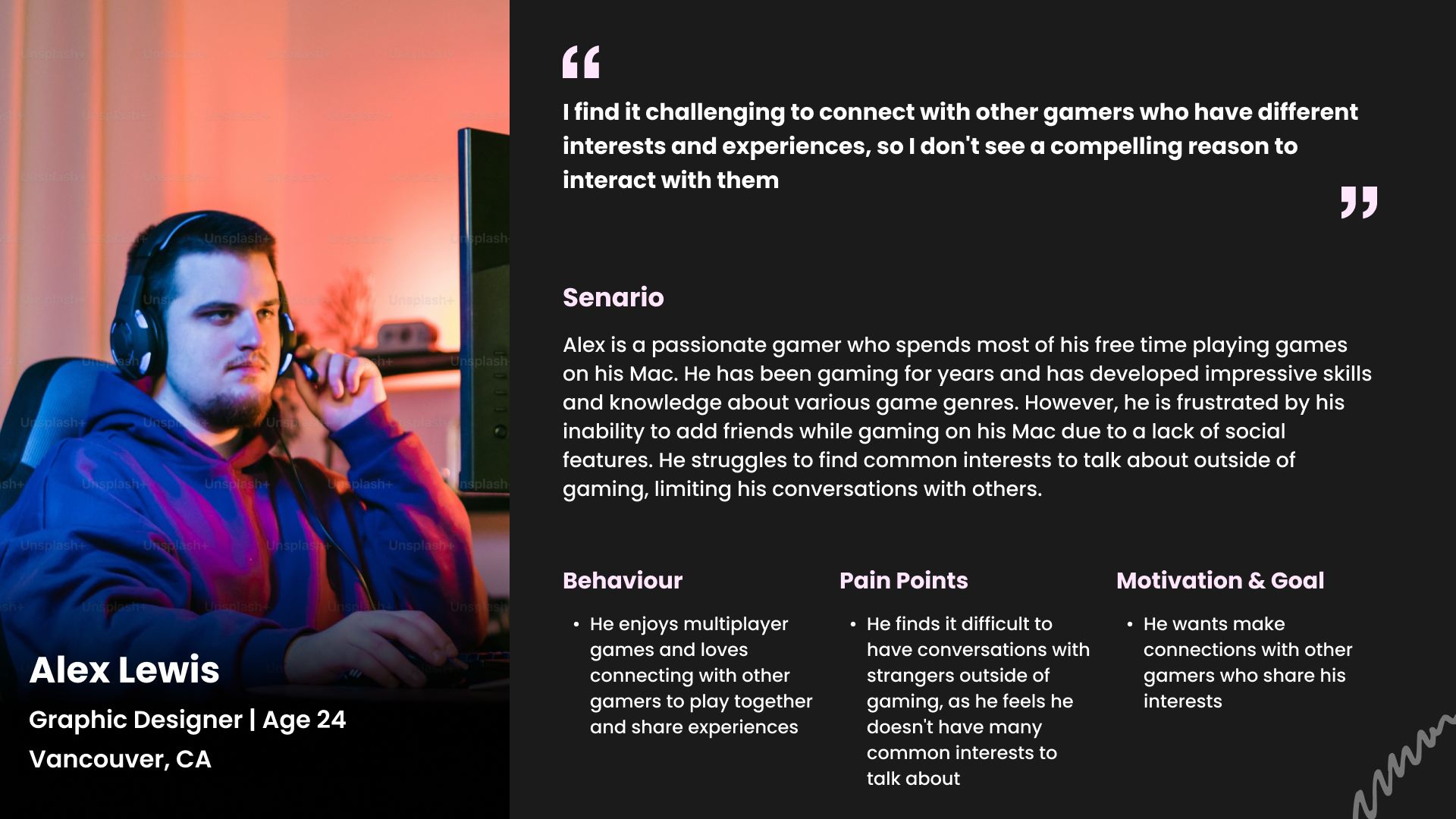
Alex Lewis
Graphic Designer · Age 24 · Vancouver, CA
“I find it challenging to connect with other gamers who have different interests and experiences, so I don't see a compelling reason to interact with them”
Scenario
Alex is a passionate gamer who spends most of his free time playing games on his Mac. He has developed strong skills across genres—but Mac lacks social features for adding friends in-game. He struggles to find common interests outside gaming, which limits conversations with others.
- Behaviour
- Enjoys multiplayer games and connecting with other gamers to play together and share experiences.
- Pain points
- Hard to talk with strangers outside gaming—feels he doesn't have enough shared interests to sustain a conversation.
- Motivation
- Wants to make connections with other gamers who share his interests—not just the same game library.
What we designed for
Alex needs to find people through shared interests—not just game titles. Each principle below drove a specific decision in the task flow and wireframes.
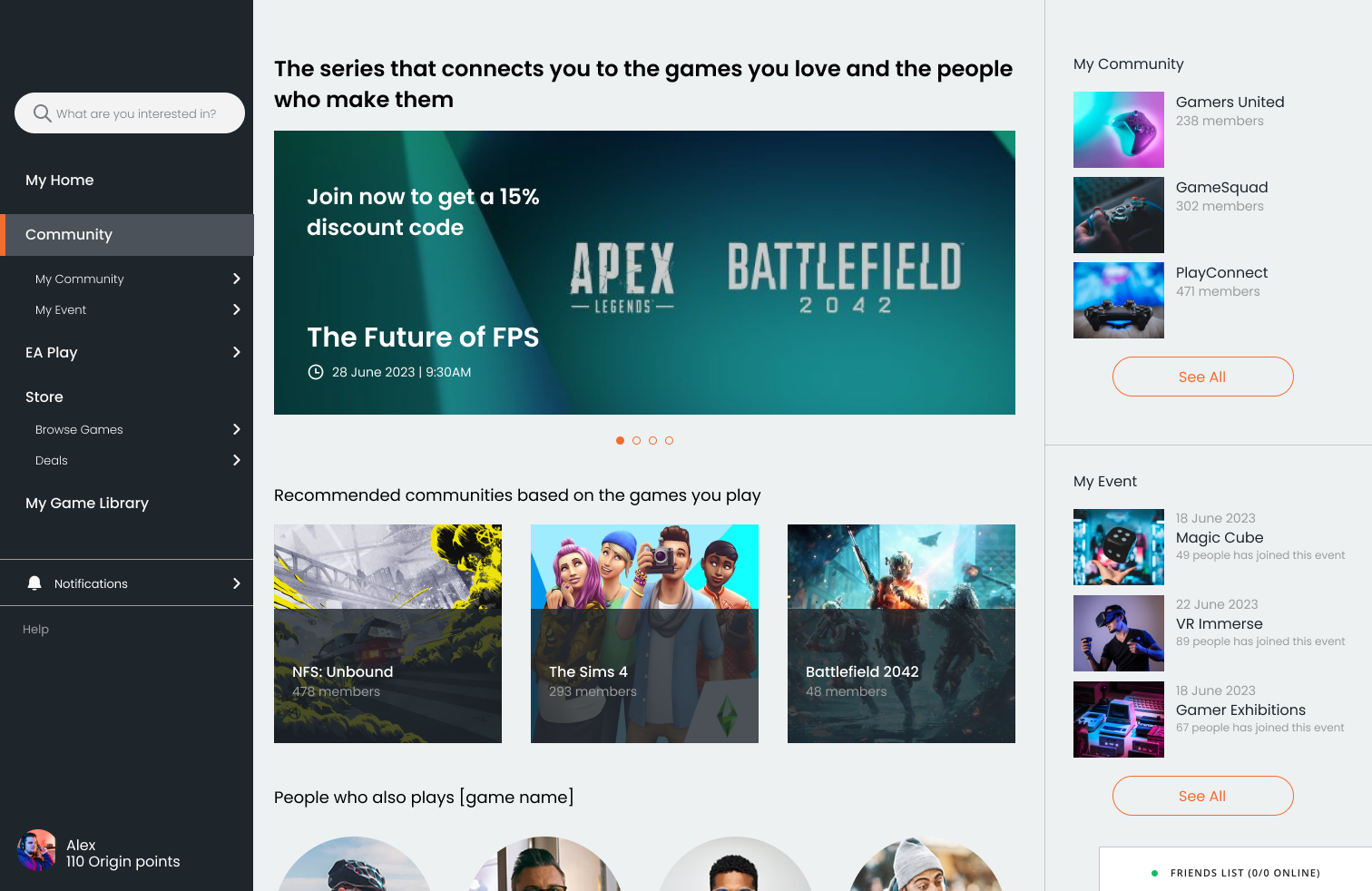
Search before browse — Keyword search surfaces relevant communities immediately rather than forcing users through a directory. The wireframe uses “What are you interested in?” as the entry point.
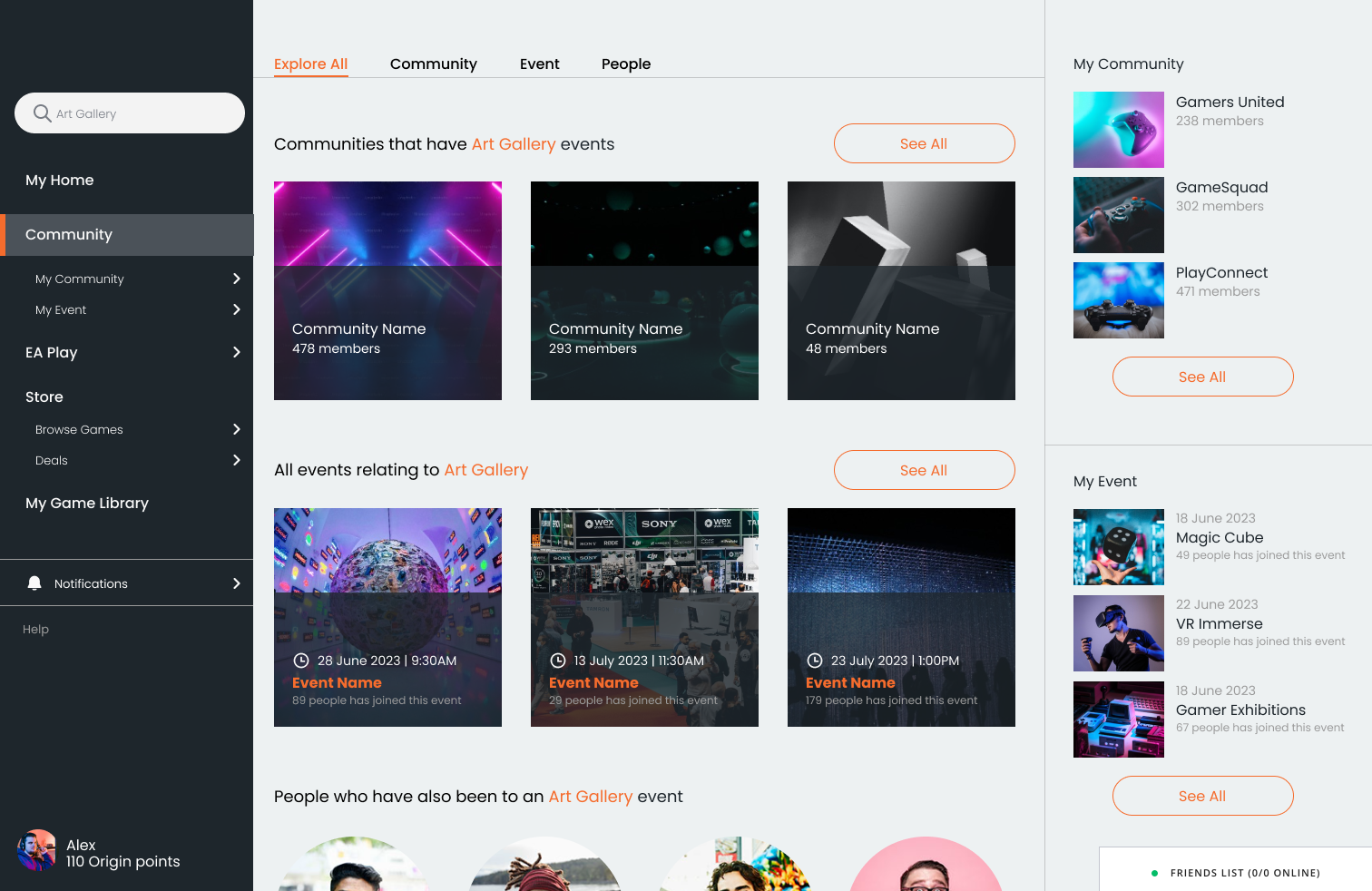
Interest over title — Search results group communities, events, and people around a shared keyword (e.g. Art Gallery)—not just which franchise you play.
Join with context — Community profiles preview bio, member count, and upcoming events before commitment.
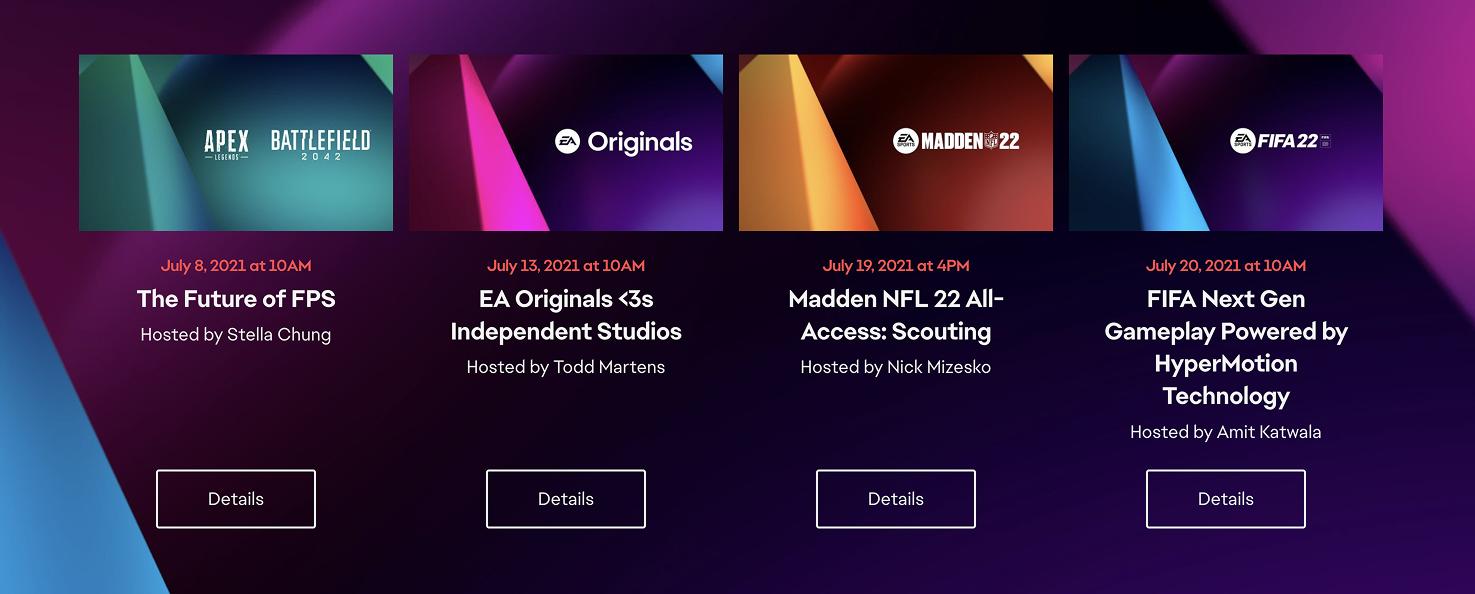
Events as on-ramps — Event cards with host, schedule, and a Details CTA give a low-stakes path to participate before joining a community full-time.
Community discovery end-to-end
The flow I delivered for the team—color-coded by step type in the original diagram (screens, user actions, system responses). Search and keyword matching sit early; event registration closes the loop.
Start
StartCommunity Screen
ScreenInput keyword in search bar
ActionShow communities matching keywords
SystemSurfaces groups where users can meet people with common interests—not just shared game titles.
Select a community to join
ActionCommunity Profile
ScreenBio description · member count · offline & online event list
Select an event
ActionEvent Screen
ScreenJoin Event CTA · event summary · details · similar event recommendations
Register for event
ActionEnd
End
Browse vs. interest-based search
Two states of the Community Screen—default game-based recommendations, then keyword-driven results when Alex searches for a shared interest.
Event discovery and registration path
From Community Profile, users pick an event and land on a detail screen with summary, Join Event CTA, and similar-event recommendations.
What I'd do with more time
This project stayed at flow and wireframe stage—the 24-hour constraint meant prioritizing direction over pixels. With more time, I'd validate the search-first IA with quick usability tests, flesh out community profile content hierarchy, and pressure-test event registration against real player mental models.
The engineering team did build a working prototype that validated technical feasibility. I don't have a visual record of that build—what's documented here is the UX direction I owned before handoff.